whatsapp:+86 13622680352



What Mobile Robots Really Need from a Precision Planetary Gearbox
Introduction
Mobile robots are no longer a niche automation product. They are now becoming a core part of modern logistics, warehousing, manufacturing, healthcare, and service operations. As the mobile robot market grows, the demand for high-performance drivetrain components is rising with it.
According to Interact Analysis, the global market for precision gearboxes and geared motors used in mobile robots is forecast to grow from $129 million in 2023 to more than $850 million by 2028, with a projected CAGR of 45.9%. The same analysis also states that planetary precision gearboxes and geared motors will see the strongest growth among the main precision gearbox categories. In a separate forecast, Interact Analysis says mobile robots are expected to become the largest industry for planetary precision gear products by 2026, accounting for about 18% of products sold, up from 4.3% in 2022.
That growth reflects a simple reality: mobile robots need drivetrain solutions that are compact, efficient, durable, smooth, and practical to integrate. This is exactly where a precision planetary gearbox has strong advantages.
But today, the conversation is going one step further.
Robot manufacturers are no longer looking only for a gearbox. More and more customers want a ready-to-integrate drive unit that combines the servo motor, encoder, brake, planetary gearbox, and controller into one coordinated module. This shift is changing the role of gearbox manufacturers—from component suppliers to module solution providers. Bosch Rexroth’s ROKIT Motor is a clear example of this trend: it combines the wheel, gearbox, brake, motor, encoder, and controller into one all-in-one wheel drive unit for AGV and AMR platforms. Maxon describes a similar direction, offering compact AGV drive systems built from motor, gearhead, encoder, and optional brake, controller, and wheel.
Why the Gearbox Matters So Much in Mobile Robots
In a mobile robot, the drive system directly affects:
- acceleration and deceleration
- motion smoothness
- battery efficiency
- wheel torque output
- navigation stability
- noise level
- service life
- integration complexity
Unlike many traditional industrial machines, AGVs, AMRs, service robots, and light industrial robots often operate in space-constrained, battery-powered, human-shared environments. That means the gearbox cannot be judged only by ratio and torque. It must support the full operating logic of the robot.
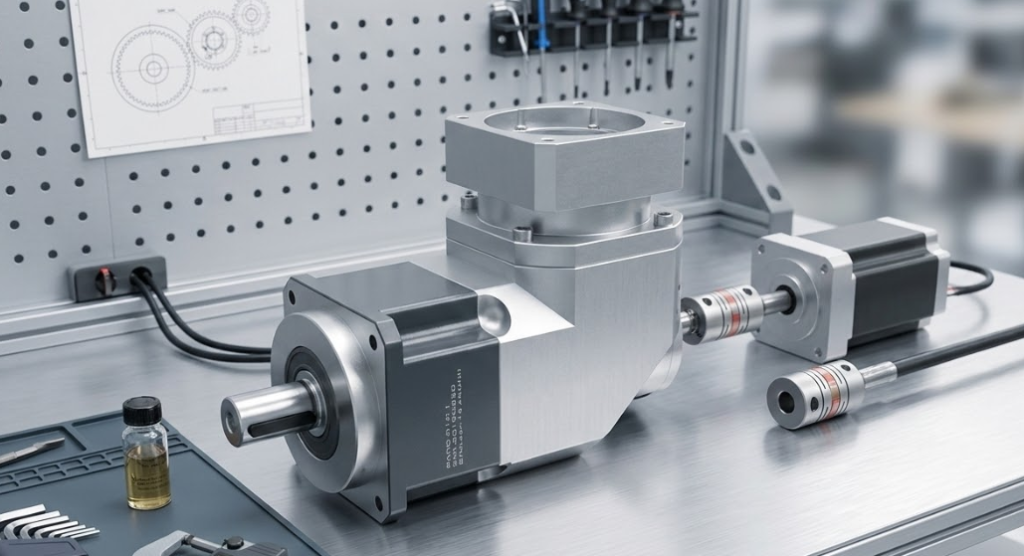
A precision planetary gearbox is one of the best fits for these requirements because it offers a balanced combination of compact size, high torque density, low backlash, high efficiency, and stable motion performance. Interact Analysis specifically notes that while planetary gearboxes do not reach the extreme precision of strain-wave or cycloidal gearboxes, they still provide very low backlash and can be a cheaper and more efficient alternative, especially in mobile robots where smooth acceleration and motion are beneficial.
What Mobile Robots Really Need from a Precision Planetary Gearbox
1. Compact Design for Space-Limited Drive Modules
Space is always limited inside a mobile robot. The wheel drive area often needs to accommodate the motor, gearbox, encoder, brake, wheel, mounting hardware, and electrical interfaces in a very tight layout.
A planetary gearbox is especially valuable here because its coaxial structure supports high torque output in a compact package. This makes it easier for robot manufacturers to reduce module size and simplify mechanical layout. Bosch Rexroth’s wheel drive module positioning emphasizes this exact point: maximum performance with minimum installation space.
For robot OEMs, compactness is not only a mechanical benefit. It also improves chassis design flexibility, payload allocation, and overall platform efficiency.
2. High Efficiency for Better Battery Performance
Battery-powered robots live and die by efficiency. Every percentage point of transmission loss becomes heat, wasted energy, and reduced runtime.
This is why efficiency is one of the most important requirements in a mobile robot gearbox. Interact Analysis highlights planetary precision gearboxes and geared motors as strong beneficiaries of mobile robot growth partly because they offer an attractive balance between performance and cost in drivetrain applications.
NUODUN precision planetary gear reducers are designed for high-efficiency transmission:
- Single-stage efficiency above 95%
- Two-stage efficiency above 92%
In real applications, this helps reduce power loss between motor and wheel, improving battery utilization and helping the robot operate longer between charges.
3. Low Backlash for Smoother and More Predictable Motion
Mobile robots need more than raw torque. They need clean, repeatable motion.
Low backlash helps improve:
- start-stop stability
- speed response
- turning consistency
- docking accuracy
- path tracking performance
Interact Analysis notes that planetary precision gearboxes maintain very low backlash and offer motion smoothness that is particularly attractive in mobile robot applications.
NUODUN precision planetary gear reducers provide:
- Single-stage backlash within 3 arcmin
- Two-stage backlash within 5 arcmin
This makes them well suited for AGVs and AMRs that must navigate narrow aisles, approach charging stations, align with transfer points, or move safely around operators.
4. High Torque Density for Load-Carrying Performance
Mobile robots often need to move carts, racks, pallets, medical equipment, or industrial materials. Even compact robots may need strong starting torque and continuous torque under repeated duty cycles.
A key advantage of the planetary structure is that multiple planet gears share the load, helping deliver higher torque density in a smaller package. That is why planetary gearboxes are widely used in motion control and robotics applications where compactness and output performance must coexist. This same logic is reflected in the growing use of integrated wheel drive units in AGV and AMR platforms.
NUODUN precision planetary gear reducers are designed to offer:
- higher torque than general standard planetary gear reducers
- high input speed up to 8000 RPM
This makes them suitable for dynamic mobile robot wheel modules that need quick response without compromising load capability.
5. Low Noise for Human-Shared Environments
Many mobile robots no longer operate in isolated industrial cells. They now move through warehouses, hospitals, electronics factories, and commercial environments where people are nearby.
Noise is therefore becoming a practical engineering concern. A quieter drivetrain improves user acceptance and creates a better operating environment.
NUODUN precision planetary gear reducers are designed for:
- low noise below 65 dB
For AMRs and service robots, low-noise performance is especially valuable in indoor deployment scenarios.
6. Long-Term Stability Under Continuous Duty
A mobile robot may run for many hours each day, often with repeated acceleration, braking, turning, and load changes. Under these conditions, the gearbox must maintain both durability and precision over time.
NUODUN precision planetary gear reducers use:
- high-strength alloy steel
- full gear hardening treatment, not just surface hardening
This supports long-term wear resistance and helps the gearbox maintain its original accuracy over extended operation. For robot fleets, that matters because drivetrain stability directly affects maintenance planning, service intervals, and total lifecycle cost.
7. Flexible Ratios for Different Robot Platforms
Different mobile robots have very different design priorities. A compact hospital robot, a warehouse AMR, and a light industrial service robot may all require different speed-to-torque balances.
That is why ratio flexibility matters.
NUODUN precision planetary gear reducers use a modular design that allows gearbox stages to be combined, supporting reduction ratios of more than 1/1000. This gives engineers greater flexibility when matching wheel diameter, motor speed, chassis weight, and target motion profile.
For OEMs building multiple robot platforms, flexible ratio design can simplify development across a broader product portfolio.
Why Integration Is Becoming More Important Than the Gearbox Alone
The next big change in the market is not only about gearbox performance. It is about integration.
More robot manufacturers now prefer to buy a direct-installation drive unit rather than separately sourcing the motor, gearbox, encoder, brake, and controller and then integrating them in-house. Bosch Rexroth explicitly positions its ROKIT Motor as a plug-and-drive all-in-one wheel drive for AGV and AMR systems, designed to reduce development effort, wiring complexity, installation space, and maintenance cost. Maxon presents a similar concept with compact AGV drive systems that can be configured as a coordinated assembly.
This trend is important because it changes the competitive landscape.
In the past, a planetary gearbox manufacturer could compete mainly on:
- backlash
- ratio
- torque
- noise
- price
Today, that is no longer enough in many robot applications.
Customers increasingly care about:
- ease of integration
- compact all-in-one packaging
- controller compatibility
- wiring reduction
- safety interface readiness
- commissioning speed
- long-term maintainability
In other words, the gearbox is still critical—but it is now judged as part of a larger drive module architecture.
That is why planetary gearbox suppliers are increasingly moving from being part suppliers to becoming module solution providers.
What OEMs Should Look for in a Precision Planetary Gearbox Supplier
When selecting a supplier for AGV, AMR, service robot, or light industrial robot projects, buyers should evaluate more than catalog specifications.
A strong supplier should be able to support:
Mechanical performance
- low backlash
- high torque density
- high transmission efficiency
- low noise
- stable long-life gearing
Integration capability
- compatibility with servo motors
- encoder matching support
- brake adaptation
- mounting customization
- compact packaging for wheel modules
Project support
- ratio selection
- application-based customization
- OEM/ODM cooperation
- stable production quality
- long-term technical support
This is where the supplier’s role becomes strategic. In a fast-growing robotics market, the best suppliers are the ones that help OEMs shorten development cycles and reduce integration risk.
Typical Applications of Precision Planetary Gearboxes in Robotics
Precision planetary gear reducers are widely used in:
- AGV wheel drive modules
- AMR drive systems
- service robots
- light industrial robots
- logistics automation systems
- robot transfer platforms
- lifting and positioning systems
- industrial automation equipment
As mobile robot deployment expands, the need for compact and efficient drive technology will continue to increase. Interact Analysis expects mobile robots to remain the strongest growth engine within the precision gearbox and geared motor market, clearly outperforming the broader automation market.
Conclusion
What mobile robots really need from a precision planetary gearbox is not just a reduction ratio.
They need a gearbox that helps deliver:
- compact drive architecture
- high efficiency for battery-powered operation
- low backlash for accurate motion
- high torque density for real workloads
- low noise for indoor use
- long-term stability for fleet reliability
- compatibility with integrated drive module design
And increasingly, they need all of this as part of a coordinated drive solution, not a standalone component.
That is why the market is moving toward more integrated drive modules built around the combination of servo motor + encoder + brake + planetary gearbox + controller. This shift is redefining what customers expect from drivetrain suppliers in AGV, AMR, service robotics, and light industrial robotics.
NUODUN is a planetary gear reducer manufacturer. We support customized solutions for mobile robots, integrated drive modules, and industrial automation applications.