whatsapp:+86 13622680352



Gearbox Oil Leakage: Causes, Prevention, and Fast Repair Methods
Gearboxes are critical power-transmission components in industrial equipment. When a gearbox begins to leak oil, the consequences can be severe: accelerated wear, overheating, gear scuffing, and even catastrophic failure. Oil leakage also leads to environmental contamination, foundation corrosion, safety hazards, and wasted lubricants.
For industries that operate continuously—cement plants, steel mills, chemical processing, conveyor systems, mining equipment—gearbox reliability is essential. Understanding why gearboxes leak and how to repair them correctly can significantly reduce downtime and maintenance costs.
This article provides a complete engineering analysis of gearbox oil leakage, its root causes, practical repair techniques, and real-world application cases. The content is based on extensive field experience and NUODUN’s expertise as an OEM transmission equipment manufacturer.
1. Why Gearboxes Leak Oil: Root Cause Analysis
Oil leakage is rarely caused by a single factor. It usually results from a combination of mechanical, thermal, and installation-related issues.
Below are the primary engineering causes.
1.1 Internal Pressure Build-Up
A gearbox is a closed environment. During operation:
- Meshing gears generate frictional heat
- Internal air expands as temperature rises
- Oil splashes inside the housing
- Pressure increases according to Boyle’s law
When pressure becomes too high and venting is insufficient, oil forces its way through any weak seal, gasket, or joint.
This is one of the most common leakage mechanisms.
1.2 Poor Structural or Venting Design
Some older or low-cost gearboxes are designed without an adequate breather (vent hood).
Without proper ventilation:
- Pressure cannot equalize
- Temperature rises faster
- Oil splashes accumulate around seals
- Leakage becomes inevitable
A missing or undersized breather is a major design flaw that should be corrected.
1.3 Excessive Oil Fill Level
Overfilling the gearbox is a frequent mistake.
When oil level is too high:
- Oil foam forms during operation
- Oil splashes reach seals and joint surfaces
- Oil collects around shaft openings
- Leakage increases dramatically
A correct oil level should allow gears to dip into the oil bath—not be fully submerged.
1.4 Poor Maintenance or Improper Repair Work
Maintenance errors are also a major contributor:
- Seal surfaces not cleaned properly
- Wrong type of sealant used
- Seal installed backwards
- Old seals reused instead of replaced
- Inaccurate bolt tightening torque
Even small mistakes in assembly can reduce sealing effectiveness.
2. Effective Engineering Measures to Prevent Gearbox Leakage
If leakage is not controlled early, oil starvation may occur, causing wear, pitting, scuffing, and tooth surface failure.
Below are proven engineering solutions.
2.1 Install a Proper Venting System (Pressure Equalization)
Internal pressure is the root cause of many leakage issues.
A gearbox must have a properly sized and functional breather cap.
How to check if the breather is too small:
- Remove breather cap cover
- Run gearbox at high speed for 5 minutes
- Place hand near vent opening
- If strong pressure is felt → breather is undersized
Solution: replace with a larger or elevated vent hood.
2.2 Improve Oil Drainage and Flow Path (“Free Flow Principle”)
Oil that splashes onto the housing should flow back freely to the sump instead of pooling around seals.
Effective methods:
- Design half-round grooves along the housing cover to guide oil downward
- Add return-flow channels behind shaft seals
- Ensure sealing lips are not submerged in oil
Preventing oil accumulation around shaft seals reduces leakage risk significantly.
2.3 Improve Shaft Seal Structure
Shaft seals are a common leakage point. Depending on the gearbox output shaft type, different strategies apply.
(1) Gearboxes With Semi-Shaft Output (Most Common Types)
These gearboxes are easier to modify.
Recommended upgrade:
- Remove coupling and old seals
- Machine a new groove on the outer side of the end cap
- Install a high-quality spring-loaded skeleton oil seal
- Keep the spring side facing inward
- If space allows: install a spare oil seal outside
This allows rapid replacement without dismantling the gearbox in the future.
(2) Gearboxes With Integrated (Solid) Output Shaft
These gearboxes do not have a detachable coupling, making seal replacement more difficult.
Practical solution:
- Use a split-type end cover
- Machine a groove on the outer side
- Cut the oil seal open, fit around shaft, then glue the joint
- Install the spring afterward
- Insert into the end cap as a complete unit
This design greatly reduces labor and avoids full gearbox disassembly.
2.4 Apply Advanced Polymer Composite Materials
Polymer composite materials (such as metal-polymer repair compounds) offer exceptional:
- Adhesion
- Chemical resistance
- Oil resistance
- Crack filling capability
- Flexibility to withstand gearbox vibration
These materials are ideal for repairing:
- Static sealing leaks
- Casting porosity
- Joint surface leakage
- Minor cracks
- Pitting and surface defects
Key benefits:
- No need to disassemble gearbox
- Quick cure time
- Long-lasting, robust sealing
- Suitable for complex or inaccessible areas
For emergency repair during operation, polymer “oil-stop repair compounds” can temporarily prevent oil leakage until scheduled maintenance.
3. Real-World Application Cases Using Polymer Composite Repair
Below are two typical examples demonstrating the effectiveness of polymer materials.
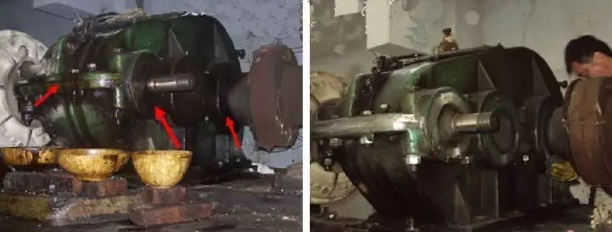
Case 1: Ball Mill Gearbox Leakage Across Multiple Units
A raw material workshop operated eight ZQ650 gearboxes (installed in 1998).
All eight exhibited varying degrees of oil leakage, with two having severe leakage around:
- Upper & lower housing joint surfaces
- Bolt holes
- Entire perimeter of casing
Repair approach:
- Clean oil and contaminants
- Expose metallic surface
- Apply polymer composite repair material
- Reinforce with protective wear-resistant overlay
The repair stopped leakage immediately and improved sealing performance long-term.
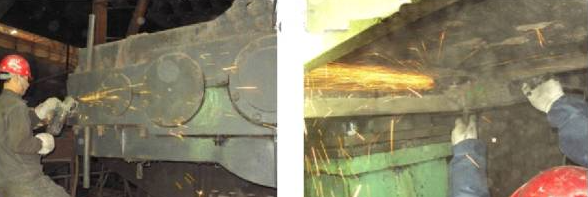
Case 2: Steel Plant Converter Tilting Gearbox Leakage
A stainless-steel division reported leakage in the tilting-drive gearbox of the converter furnace.
Repair process:
- Clean external oil residues
- Grind leaking surfaces to expose bright metal
- Rinse with anhydrous ethanol
- Prepare polymer composite material 25551
- Apply onto joint surfaces showing seepage
- Cover with polymer rubber material 3223 for reinforcement
The composite solution provided a durable seal resistant to temperature, vibration, and oil exposure.


Frequently Asked Questions (FAQ)
1. What is the primary cause of gearbox oil leakage?
Internal pressure build-up combined with insufficient venting is the most common cause.
2. Is polymer composite repair a permanent solution?
Yes—when applied correctly. It provides excellent adhesion, oil resistance, and vibration tolerance.
3. How often should gearbox seals be replaced?
Typically every 1–3 years depending on load, environment, and operating temperature.
4. Does overfilling oil always cause leakage?
Often yes. Excess oil splashes directly onto shaft seals, increasing leakage risk.
5. Can leakage be fixed without disassembling the gearbox?
Yes. Polymer composite materials allow external repair without dismantling.
6. Why is venting important?
Without pressure equalization, oil is forced through the weakest sealing point.
Conclusion: Preventing Gearbox Leakage Requires Engineering, Not Just Patching
Gearbox oil leakage is serious—but preventable.
Most leakage problems originate from:
- Internal pressure build-up
- Poor venting design
- Excessive oil level
- Incorrect seal installation
- Aging or worn components
- Inadequate maintenance
By combining proper design, correct installation practices, improved sealing systems, and advanced polymer repair technologies, industries can greatly reduce leakage incidents and extend gearbox life.
NUODUN Provides OEM Gearbox Solutions & Professional Engineering Support.