whatsapp:+86 13622680352



5 Key Advantages of Using a Gear Reducer in Motor-Driven Machinery
Introduction: Why Gear Reducers Matter in Modern Machinery
In almost every industrial sector—manufacturing, logistics, energy, automation, and robotics—electric motors are the primary source of motion. However, motors alone rarely deliver the exact speed and torque that machines actually need.
This is where gear reducers play a critical role.
A gear reducer sits between the motor and the driven machine, converting the motor’s high-speed, low-torque output into lower speed and higher torque, optimized for real operating conditions. While this concept seems simple, the practical benefits are substantial.
Below, we explore the five key advantages of using a gear reducer, explaining not just what they are, but why they matter from an engineering, operational, and economic perspective.
Advantage 1: Torque Multiplication Without Increasing Motor Size
Smaller Motors Can Do Bigger Jobs
One of the most fundamental advantages of using a gear reducer is torque multiplication.
Electric motors are typically designed to operate efficiently at relatively high speeds. Torque output at the motor shaft is limited by motor size, cost, and electrical constraints. By introducing a reducer, you can:
- Reduce rotational speed
- Convert “excess” speed into usable torque
- Drive heavier loads with the same motor
For example:
- A motor running at 1,500 rpm may not have enough torque to drive a loaded conveyor directly.
- With a 20:1 gear reducer, the output speed drops to 75 rpm while torque increases roughly 20 times (minus efficiency losses).
Cost and Space Benefits
Instead of selecting:
- A larger motor
- Higher current ratings
- Bigger cables and drives
You can often use:
- A smaller, more economical motor
- A properly sized gear reducer
This results in lower system cost, smaller footprint, and easier installation, especially important in compact machinery and OEM equipment.
Advantage 2: Controlled and Optimized Output Speed
Matching Motor Characteristics to Machine Requirements
Motors operate most smoothly and efficiently within specific speed ranges. Machines, however, often require slow, steady, and controlled motion.
A gear reducer allows engineers to:
- Select a motor that runs in its optimal speed range
- Match output speed precisely to the machine’s needs
- Avoid unstable low-speed motor operation
This is particularly valuable in applications such as:
- Conveyors
- Mixers and agitators
- Indexing tables
- Positioning and feeding systems
Instead of forcing a motor to run slowly—where cooling and torque control may be poor—the motor runs efficiently while the reducer handles speed matching.
Improved Process Control
By selecting the appropriate reduction ratio:
- Speed becomes predictable and repeatable
- Process control improves
- Mechanical overshoot and vibration are reduced
This leads to better product quality, smoother operation, and more consistent performance across the machine’s service life.
Advantage 3: Higher Energy Efficiency and Reduced Motor Stress
Let the Motor Work Where It’s Most Efficient
Electric motors achieve their highest efficiency when operating near their rated speed and load. Running a motor too slowly or too heavily loaded can lead to:
- Increased current draw
- Excessive heat generation
- Reduced efficiency
A gear reducer allows the motor to:
- Operate near its optimal efficiency point
- Deliver required torque indirectly through gearing
As a result:
- Electrical losses are reduced
- Motor temperature stays lower
- Energy consumption decreases
Over time, these improvements translate directly into lower operating costs.
Reduced Electrical and Thermal Stress
By lowering the mechanical load on the motor:
- Bearings last longer
- Windings experience less thermal cycling
- Insulation degradation slows
This significantly improves motor reliability and service life, especially in continuous-duty industrial environments.
Advantage 4: Longer Equipment Life and Lower Maintenance Costs
Mechanical Stress Is Managed Where It Belongs
In a well-designed drive system, the gear reducer absorbs:
- Load fluctuations
- Shock loads
- Starting and stopping stresses
Instead of these forces acting directly on the motor or machine structure, they are handled by components designed specifically for mechanical load transmission.
This protects:
- Motor shafts and bearings
- Couplings
- Driven machine components
Reduced Wear and Fewer Failures
Because mechanical stress is better distributed:
- Wear rates decrease
- Unexpected failures are reduced
- Maintenance intervals are extended
Many modern reducers are:
- Fully sealed
- Lifetime lubricated or long-interval lubricated
- Designed for continuous industrial duty
This further lowers maintenance requirements and total cost of ownership.
Advantage 5: Greater Design Flexibility and System Optimization
One Motor Platform, Many Applications
Gear reducers give designers flexibility to use:
- Standard motors
- Multiple reduction ratios
- Different mounting configurations
With the same motor model, you can:
- Drive different machines
- Adjust output speed by changing reducer ratio
- Optimize torque without redesigning the electrical system
This is especially valuable for OEM manufacturers who want to standardize components while offering multiple machine variants.
Compact and Integrated Drive Solutions
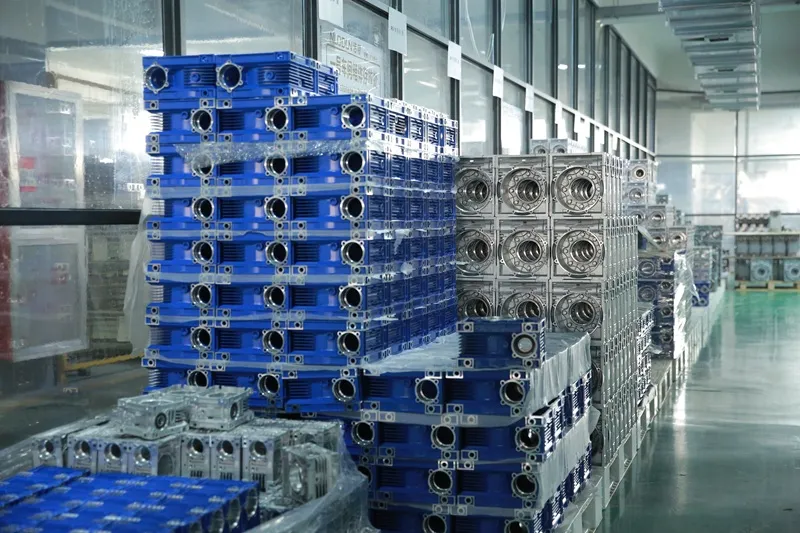
Modern reducers are available in:
- Foot-mounted designs
- Flange-mounted designs
- Hollow-shaft or solid-shaft outputs
- Inline or right-angle layouts
This makes it easier to integrate them into tight spaces and complex machine layouts without compromising performance.
Why Gear Reducers Are a Standard in Industrial Drives
Taken together, these advantages explain why gear reducers are used in:
- Conveyors and material handling
- Packaging and processing equipment
- Automation and robotics
- Energy and environmental systems
They are not just accessories—they are core components of efficient mechanical design.
As a professional transmission equipment manufacturer, NUODUN designs and produces gear reducers specifically to deliver these benefits across a wide range of industrial applications.
Common FAQs (Frequently Asked Questions)
Q1: Does using a gear reducer always increase efficiency?
In most industrial applications, yes. By allowing the motor to operate near its optimal efficiency point, overall system efficiency typically improves.
Q2: Can a gear reducer reduce motor size?
Yes. In many cases, a reducer allows a smaller motor to deliver the required output torque, reducing both cost and space.
Q3: Are gear reducers high-maintenance components?
Modern reducers are designed for long service life with minimal maintenance, especially sealed or lifetime-lubricated models.
Q4: Do reducers affect system reliability?
Positively. By absorbing mechanical stress and load variations, reducers protect both the motor and the driven machine.
Q5: Does NUODUN support OEM gear reducer solutions?
Yes. NUODUN provides OEM and ODM gear reducer solutions, including custom ratios, mounting configurations, and integrated drive designs.
Final Summary: Why Using a Gear Reducer Makes Sense
The five key advantages of using a gear reducer can be summarized as follows:
- Torque multiplication without increasing motor size
- Controlled, optimized output speed
- Higher energy efficiency and reduced motor stress
- Longer equipment life and lower maintenance costs
- Greater design flexibility and system optimization
For most motor-driven machines, a gear reducer is not optional—it is essential for performance, reliability, and cost control.
Optimize Your Drive System with NUODUN
If you are designing or upgrading machinery and want to:
- Improve torque and speed matching
- Reduce energy consumption
- Extend equipment life
- Develop OEM-level drive solutions
NUODUN is a professional transmission equipment manufacturer offering gear reducers and customized OEM drive solutions for industrial applications worldwide.
Contact NUODUN today to discuss your application and find the right gear reducer for your machine.
You can Get more: