whatsapp:+86 13622680352



How to Size a Multi-Point Screw Jack Lifting System
A multi-point screw jack lifting system should be sized from the load at the most heavily loaded lifting point, not simply by dividing the total load by the number of jacks. Engineers must also check uneven load distribution, safety factor, lifting speed, duty cycle, screw buckling, travel length, and required motor power.
For a preliminary selection, use:
Required capacity per jack = total operating load / number of jacks x uneven-load factor x safety factor
The result is only the starting point. The final selection must also pass the manufacturer’s thermal, buckling, starting-torque, and system-layout checks.
Information Required Before Selecting Screw Jacks
Collect the following information before choosing a screw jack model:
| Design input | Why it matters |
|---|---|
| Total operating load | Establishes the basic lifting requirement |
| Number and location of lifting points | Determines the nominal load per jack |
| Center of gravity | Reveals whether some jacks carry more load |
| Required travel | Affects screw length, buckling, and system layout |
| Lifting speed | Determines screw speed, ratio, and motor power |
| Duty cycle and starts per hour | Determines thermal suitability |
| Guided or unguided load | Changes lateral-load and buckling risks |
| Environmental conditions | Influences sealing, lubrication, and material selection |
| Required positioning accuracy | Influences screw type, backlash, and feedback requirements |
Do not use a screw jack to resist significant side loads unless the jack and supporting structure are specifically designed for them. External guides should normally carry lateral forces.
Step 1: Calculate the Nominal Load per Jack
For a platform with a centered load:
Nominal load per jack = total operating load / number of jacks
For example, a 20,000 kg platform supported by four screw jacks has a nominal static load of:
20,000 kg / 4 = 5,000 kg per jack
This simple result is not enough for selecting the jack because real systems rarely distribute the load perfectly.
Step 2: Account for Uneven Load Distribution
Manufacturing tolerances, frame deflection, changing payload position, and an offset center of gravity can increase the load at one or more lifting points.
For preliminary sizing, engineers commonly apply an uneven-load factor based on the known structure and loading condition. A preliminary factor such as 1.20 to 1.30 may be considered for a reasonably rigid, guided platform, but the correct value must come from the actual load distribution or structural analysis.
For the worked example, assume an uneven-load factor of 1.25:
5,000 kg x 1.25 = 6,250 kg maximum expected load per jack
If the center of gravity moves during operation, calculate the reaction force at each lifting point for the worst operating position instead of relying on a general factor.
Step 3: Apply an Appropriate Safety Factor
The safety factor must reflect the consequences of failure, shock loading, vibration, starts and stops, and uncertainty in the design inputs.
For this preliminary example, assume a safety factor of 1.5:
6,250 kg x 1.5 = 9,375 kg required preliminary capacity per jack
The selected jack should therefore have a rated capacity above 9,375 kg per lifting point. The next suitable rated size may be considered, but rated capacity alone does not confirm that the jack is suitable.
Engineering note: Safety-critical lifting applications require a complete risk assessment, suitable brakes or load-holding devices, limit switches, mechanical stops, and verification according to the applicable regulations.
Step 4: Check Screw Buckling and Critical Speed
Long lifting screws under compression can fail by buckling even when the applied load is below the jack’s nominal capacity. The allowable compressive load depends on:
- Unsupported screw length
- Screw diameter and root diameter
- End-support condition
- Mounting arrangement
- Required safety factor
For long travel or high lifting speed, critical screw speed must also be checked. A rotating screw that operates too close to its critical speed can vibrate and become unstable.
Always verify buckling capacity and permissible screw speed using the selected manufacturer’s data.
Step 5: Determine Screw Speed from the Required Lifting Speed
Screw rotational speed can be estimated from:
Screw speed (rpm) = linear lifting speed (mm/min) / screw lead (mm/rev)
Assume the platform must move at 5 mm/s and the selected screw lead is 6 mm/rev:
5 mm/s x 60 = 300 mm/min
300 mm/min / 6 mm/rev = 50 rpm
The gearbox ratio and motor speed must be selected so that every connected jack operates at the required screw speed without exceeding its permissible input speed.
Step 6: Estimate Screw Torque
For preliminary comparison, the idealized lifting torque at one screw can be estimated using:
Torque = axial force x screw lead / (2 x pi x screw efficiency)
Using the preliminary design load of 9,375 kg per jack:
- Axial force: approximately 92,000 N
- Screw lead: 0.006 m/rev
- Assumed screw efficiency: 0.25
Torque = 92,000 x 0.006 / (2 x pi x 0.25)
Torque is approximately 351 N.m per jack
Actual starting and operating torque must be confirmed from the jack manufacturer’s performance data. Seal drag, lubrication, temperature, gearbox losses, couplings, and bevel gearboxes all affect the required input torque.
Step 7: Estimate Motor Power
The theoretical lifting power is:
Lifting power = total lifting force x linear speed
For the 20,000 kg platform lifting at 5 mm/s:
196,200 N x 0.005 m/s = 981 W
If the preliminary overall mechanical efficiency is assumed to be 25%:
981 W / 0.25 = 3.92 kW
Additional allowance is required for starting torque, drivetrain losses, acceleration, duty cycle, and service conditions. Motor size should be confirmed from the final jack, gearbox, and transmission-shaft selections rather than chosen from this preliminary value alone.
Worked Example Summary: Four-Jack 20-Ton Platform
| Item | Preliminary result |
|---|---|
| Total operating mass | 20,000 kg |
| Number of screw jacks | 4 |
| Nominal mass per jack | 5,000 kg |
| Uneven-load factor | 1.25 |
| Safety factor | 1.5 |
| Preliminary required capacity per jack | 9,375 kg |
| Target lifting speed | 5 mm/s |
| Assumed screw lead | 6 mm/rev |
| Required screw speed | 50 rpm |
| Estimated torque per jack | 351 N.m |
| Estimated input power before additional allowances | 3.92 kW |
These figures illustrate the sizing process. They are not a final product selection. NUODUN engineers would also verify the exact loading layout, screw buckling, duty cycle, starting torque, shaft arrangement, bevel gearbox loads, motor power, and safety requirements.
How to Keep Multiple Screw Jacks Synchronized
A mechanically synchronized system normally uses one motor to drive multiple screw jacks through gear reducers, bevel gearboxes, transmission shafts, and couplings. Because the lifting points are mechanically connected, they move together under normal operating conditions.
The layout should minimize shaft misalignment and torsional wind-up. The supporting frame must also be sufficiently rigid. A mechanically synchronized drivetrain cannot compensate for a flexible platform or an incorrectly positioned center of gravity.
For applications requiring active correction or independent lifting-point control, an electronically synchronized multi-motor system with position feedback may be more appropriate.
Common Screw Jack Sizing Mistakes
Dividing the Load Equally Without Checking the Center of Gravity
The most heavily loaded jack determines the required capacity. Calculate support reactions when the load is not centered.
Selecting Only by Rated Capacity
Rated capacity does not confirm buckling resistance, thermal suitability, permissible speed, or required starting torque.
Ignoring Duty Cycle
Trapezoidal screw jacks can generate significant heat during frequent or continuous operation. High-duty-cycle applications may require a ball screw jack or another actuator type.
Allowing the Jacks to Carry Side Loads
Side loading increases wear and can cause binding. Use external linear guides to control lateral forces.
Choosing the Motor Before Finalizing the Drivetrain
Motor power and brake requirements depend on the complete transmission layout and its real efficiency.
Multi-Point Screw Jack Selection Checklist
Before requesting a quotation, provide:
- Total load and payload position
- Drawing showing every lifting point
- Required travel and retracted height
- Lifting speed
- Duty cycle and starts per hour
- Available motor power and voltage
- Mounting orientation
- Ambient temperature and operating environment
- Required positioning accuracy
- Need for limit switches, encoder, brake, bellows, or safety nut
Frequently Asked Questions
How many screw jacks are needed for a lifting platform?
The number depends on the platform size, stiffness, load distribution, and required stability. Four jacks are common for rectangular platforms, but large or flexible structures may require additional lifting points.
Can I divide the total load equally among all screw jacks?
Only as an initial estimate for a centered load on a rigid platform. Final sizing must use the highest reaction force at any lifting point and include appropriate allowances.
Are screw jacks self-locking?
Some trapezoidal screw jack configurations may resist back-driving under specific conditions, but self-locking must never be assumed. Confirm the selected model and use a brake or other safety device where uncontrolled movement could create a hazard.
When should I choose a ball screw jack?
A ball screw jack may be preferable when the application requires higher efficiency, higher speed, or a higher duty cycle. Because ball screws can back-drive easily, a brake or load-holding system is normally required.
Can one motor drive multiple screw jacks?
Yes. A single motor can drive multiple jacks using bevel gearboxes, shafts, and couplings. The shaft layout, torque capacity, alignment, and speed must be checked as part of the complete system design.
Get a Preliminary Screw Jack System Selection
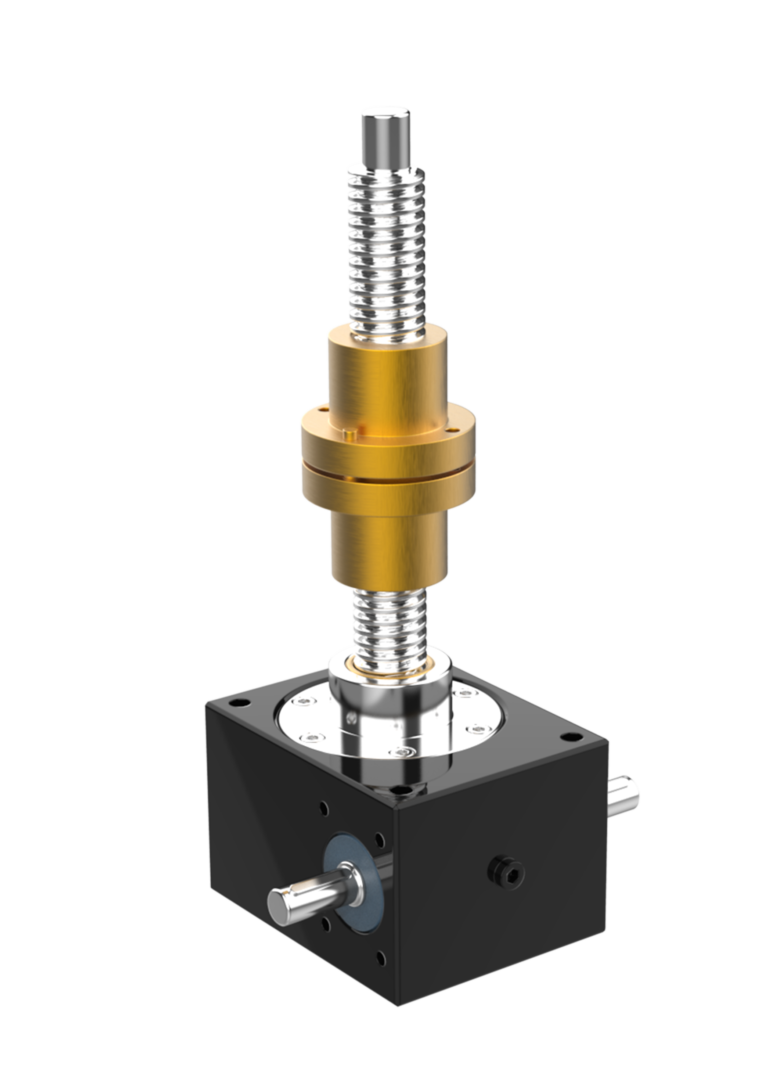
NUODUN supplies worm gear screw jacks, bevel gear ball screw jacks, gear reducers, bevel gearboxes, and complete synchronized lifting-system components.
Send the NUODUN engineering team your load, travel, speed, duty cycle, and lifting-point layout to receive a preliminary system recommendation.