whatsapp:+86 13622680352



Helical Gear Unit for AGV Wheel Drive: Compact, Quiet, High-Torque-Density Design
As AGVs and AMRs move deeper into warehouses, hospitals, malls, and mixed human-machine environments, the wheel drive system is no longer just a transmission component. It has become a critical subsystem that directly affects vehicle size, payload capability, acoustic comfort, serviceability, wiring complexity, and motion control quality. Across the market, drive suppliers increasingly emphasize highly integrated wheel-drive architectures that combine the gearbox, motor, encoder, brake, and sometimes electronics into a compact package to save installation space and simplify commissioning.
For AGV wheel drive applications, a helical gear unit is often considered when engineers need a balance of compact dimensions, high torque density, smooth meshing, and low operating noise. Helical gears are widely recognized for smoother and quieter running than simpler gear forms, and compact helical gear units are commonly promoted for low space requirements and low noise levels in industrial drive applications.
Why compactness and torque density matter
The packaging space around an AGV drive wheel is always tight. Designers must fit the gearbox, wheel, motor, brake, encoder, suspension structure, and cable routing into a limited envelope while still leaving room for batteries, safety scanners, controllers, and load structure. This is why the market keeps moving toward highly compact drive units. Bonfiglioli describes AGV/AMR wheel solutions built around compact, high-efficiency gearboxes with minimized installation space and strong radial-load support, while Framo Morat highlights compact wheel hub drives that combine multiple drive functions in a single unit.
In practical AGV design, high torque density means more usable traction and load capability without forcing the vehicle to become taller, wider, or heavier. That is especially important for low-profile robots, under-rack vehicles, hospital transport robots, and compact AMRs that must navigate narrow aisles or shared indoor spaces. Published AGV drive platforms also show the broader trend toward low-voltage, battery-oriented, space-saving mechatronic packages optimized for mobile robotics.
Why helical gear units remain attractive for AGV wheel drive
The core strength of a helical gear unit is smooth tooth engagement. Because the teeth engage progressively, the transmission tends to run more quietly and with less vibration than simpler straight-cut alternatives. NORD explicitly notes that helical gears offer smoother and quieter running, while its helical inline gear units are described as compact and low-noise.
For AGVs operating near people, this matters. In a shopping mall, hospital, office, or goods-to-person warehouse, the drive should not only move efficiently but also feel refined. Lower vibration helps motion stability, reduces audible harshness, and supports better control response from the motor and encoder system. From an engineering standpoint, that makes helical gearing attractive for wheel-drive modules where ride quality and acoustic comfort matter alongside torque output. This conclusion is an engineering inference supported by the documented quiet-running characteristics of helical gearing and the broader AGV demand for compact, integrated wheel-drive packages.
Integration is no longer optional
A modern AGV drive wheel is increasingly expected to be more than a gearbox plus motor. Suppliers now promote wheel-drive modules with integrated brakes, safety-capable encoders, sealed housings, and standard communication interfaces. Framo Morat describes wheel hub drive systems that integrate the wheel, gearbox, motor, brake, encoder, and control unit, with RS485 or CAN interfaces and modular Standard, Advanced, and Ultimate configurations. Bonfiglioli similarly highlights options such as safety encoders, holding brakes, low-voltage supply, and customizable modular combinations of motor and gearbox.
This is also consistent with the wider trend in mechatronic drives. SEW-EURODRIVE describes compact integrated drive units that combine permanent-magnet motor, gear unit, and electronics in one package, reducing cabling and installation effort while supporting multi-encoder and bus-oriented control architectures.
For AGV manufacturers, this level of integration brings three concrete benefits: cleaner wiring, faster assembly, and easier control-system standardization across vehicle platforms. It also makes it easier to design modular vehicle families, where the same electrical and mechanical interface can support different payload classes or wheel sizes.
Helical gear unit vs planetary or wheel hub solution
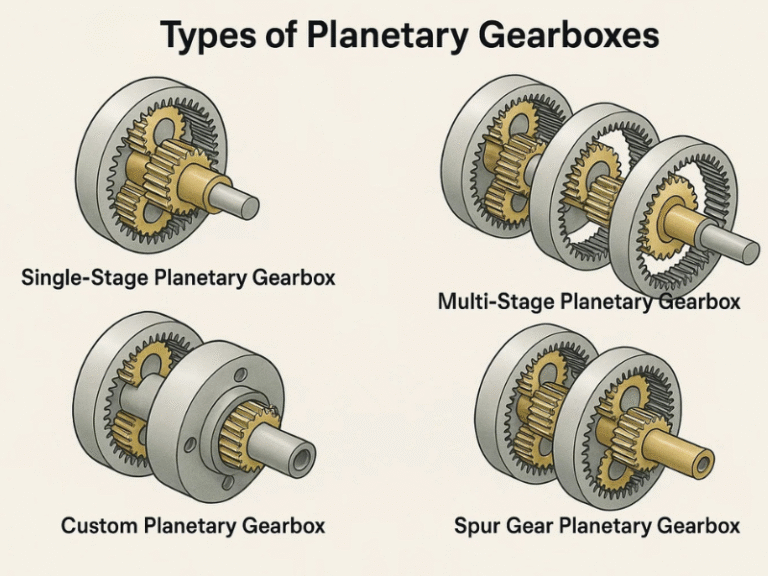
In today’s market, many AGV and AMR wheel-drive platforms are built around planetary wheel hub architectures because they are excellent for coaxial packaging, high radial-load support, and very compact wheel-centered layouts. Bonfiglioli and Framo Morat both emphasize compactness, wheel integration, radial-load capability, and modularity in their AGV wheel-drive offerings.
A helical gear unit, however, can still be the better engineering choice in certain layouts. When the design goal is quieter meshing, smoother running, flexible motor placement, or a transmission architecture that does not have to be fully coaxial with the wheel, a helical solution can be highly attractive. This is especially true when the vehicle layout allows some separation between wheel center and motor location, or when maintenance access and component replacement strategy are important considerations. The quiet-running advantage is directly supported by published helical gear data; the packaging and service implications are engineering trade-off judgments based on how these drive architectures are typically arranged.
From a cost perspective, planetary wheel-hub modules often justify themselves when compact coaxial packaging and high integration are the main priorities. But higher integration can also mean a more specialized module. By contrast, a helical gear solution may be attractive when designers want a practical balance between performance, acoustic comfort, customization flexibility, and lifecycle service strategy. Framo Morat’s modular component replacement concept and Bonfiglioli’s modular AGV platform both reflect how serviceability and customization are becoming as important as raw torque figures.
What engineers should look for in an AGV helical gear unit
For AGV wheel-drive selection, the most important technical checkpoints are not only ratio and torque. Engineers should evaluate installation length, allowable radial load at the wheel, peak and continuous torque, backlash, acoustic behavior, sealing level, brake integration, encoder compatibility, communication interface, and thermal behavior under real duty cycles. Published AGV wheel-drive platforms also show the importance of low-voltage compatibility, safety encoder options, holding brakes, sealed systems, and standardized communication such as CAN or RS485.
Just as important is modularity. A strong AGV gearbox supplier should be able to adapt the motor interface, wheel size, sealing concept, load capacity, noise optimization, and interface layout to the machine builder’s actual vehicle platform. Framo Morat explicitly describes customization of dimensions, load capacity, gear ratios, noise behavior, and interfaces, while Bonfiglioli promotes modular AGV/AMR configurations with different motors, feedback systems, brakes, and low-voltage options.
The direction of the market
The technical direction is clear: AGV and AMR drive systems are becoming more integrated, more modular, and more interface-standardized. Suppliers increasingly package wheel, gearbox, motor, brake, encoder, controller, and communication layers into scalable drive modules. Some go further with safety functions, real-time operating data, and predictive-maintenance-oriented sensing.
That does not mean every application should use the same architecture. Instead, it means gearbox selection is becoming more application-specific. For some AGVs, a planetary wheel hub module will be the best answer. For others, a helical gear unit may provide the quieter, smoother, and more layout-flexible solution that the machine builder really needs. The best choice comes from matching transmission architecture to duty cycle, available space, control strategy, and service model rather than following a single industry trend. This comparative conclusion is an engineering synthesis of the published characteristics of helical and wheel-hub drive solutions.
Why NUODUN
For AGV and AMR builders looking for a more application-driven solution, NUODUN positions itself as a UK gear reducer supplier that supports customization. That matters when your project needs more than a catalog gearbox — for example, a compact helical gear unit with application-specific torque output, motor interface, encoder matching, brake integration, wheel-side packaging, or low-noise optimization for human-machine shared environments.
Rather than treating the gearbox as a generic commodity, the better approach is to treat the AGV drive wheel as a system. When compact size, quiet motion, and integration quality all matter at the same time, a customized helical gear solution can create real value at vehicle level.
FAQ
1. Why use a helical gear unit in an AGV wheel drive?
A helical gear unit is often chosen because helical gearing provides smoother and quieter running, while compact helical gear units are also promoted for low space requirements and efficient operation. In AGVs operating around people, that can improve acoustic comfort and motion smoothness.
2. Is a planetary wheel hub solution always better than a helical gear solution for AGVs?
Not always. Planetary wheel hub modules are very strong in coaxial compactness, radial-load handling, and high integration, which is why many AGV/AMR drive platforms use them. But a helical gear solution may be preferable when quieter running, different packaging geometry, or a specific service strategy is more important. The second point is an engineering trade-off inference based on published characteristics.
3. What components are commonly integrated into a modern AGV drive wheel unit?
Depending on the platform, the integrated unit may include the wheel, gearbox, motor, holding brake, encoder, controller, and communication interface. Framo Morat and Bonfiglioli both describe such integrated modular wheel-drive systems for AGV and AMR use.
4. Which interfaces are common in AGV drive modules?
Standard serial interfaces such as RS485 and CAN are commonly highlighted for wheel hub drive communication, while broader mechatronic drive platforms also support industrial bus and multi-encoder architectures.
5. What matters more in AGV gearbox selection: torque or noise?
Both matter. Torque determines traction and payload capability, but noise and vibration matter greatly in indoor AGV use, especially in hospitals, commercial buildings, and mixed human-robot environments. That is one reason quiet-running gear architectures remain important.
6. Are AGV drive wheel systems moving toward more standardization?
Yes. Current product platforms increasingly emphasize modular design, standard interfaces, scalable configurations, and plug-and-play integration. Safety encoders, holding brakes, controller integration, and data-enabled monitoring are also becoming more common.
7. Can a gearbox supplier customize an AGV wheel-drive solution?
Yes. Published AGV drive platforms show growing emphasis on application-specific customization, including motor adaptation, dimensions, gear ratios, torque, interfaces, load capacity, and environmental protection features.
8. What should buyers ask a supplier before selecting an AGV helical gear unit?
Ask about continuous and peak torque, allowable radial load, noise performance, backlash, duty cycle, brake and encoder options, sealing level, communication interface, motor compatibility, and customization capability. These points align with the technical configuration options now common in AGV/AMR drive platforms.