whatsapp:+86 13622680352



Common Gear Reducer Failures and Effective Troubleshooting Measures
Introduction: Understanding Gear Reducer Failure Patterns
Gear reducers are essential components in modern power transmission systems, widely used in manufacturing equipment, conveyors, cranes, energy systems, and automated production lines. Due to continuous operation under load, exposure to harsh environments, and complex mechanical interactions, gear reducers inevitably experience wear and failure over time.
Field experience shows that most gear reducer failures are concentrated in three core systems:
- Sealing system
- Lubrication system
- Transmission system
Accurate fault identification and targeted corrective measures are critical to preventing minor issues from escalating into severe mechanical damage. This article provides a systematic breakdown of common gear reducer failures, their root causes, and engineering-level troubleshooting solutions.
1. Oil Leakage Failures in Gear Reducers
Oil leakage is the most common and visible fault in gear reducers. It typically occurs at sealing surfaces, oil windows, drain plugs, and the gearbox bottom. Effective troubleshooting requires identifying the exact leakage location and applying corresponding repair measures.
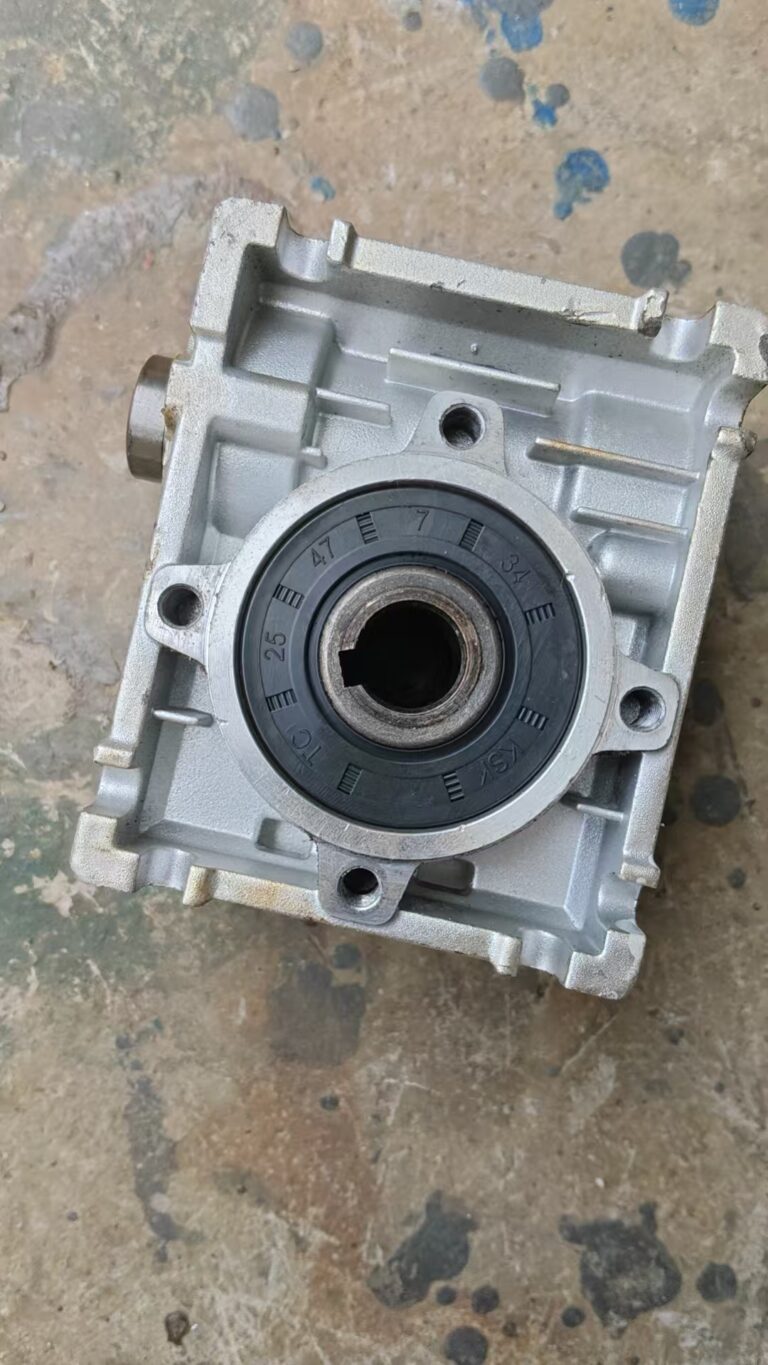
1.1 Input Shaft Oil Seal Leakage
Typical Causes
- Aging or damaged oil seals
- Improper installation
- Degraded sealing compound
Corrective Measures
- Disassemble the shaft-end sealing assembly
- Remove residual sealant and oil contamination from the seal groove
- Replace the oil seal with a model-matched radial shaft seal, preferably fluororubber (FKM) for improved oil and heat resistance
- Apply a 3–5 mm layer of oil-resistant sealant (e.g., Loctite 587) evenly in the seal groove
- Ensure the sealing surface is continuous, free of air bubbles or breaks
- Allow the sealant to cure for at least 24 hours before test operation
This process ensures long-term sealing stability under thermal expansion and vibration.
1.2 Gearbox Housing Joint Surface Leakage
Typical Causes
- Loose or stripped fastening bolts
- Uneven contact pressure
- Aged or improperly applied sealant
Corrective Measures
- Inspect all housing bolts for loosening or thread damage
- Tighten bolts using a torque wrench in a diagonal sequence, following manufacturer specifications (typically 25–35 N·m)
- Replace stripped bolts with high-strength fasteners (grade 8.8 or higher)
- Clean old sealant thoroughly using a scraper and alcohol until surfaces are oil-free
- Apply anaerobic sealant (e.g., Loctite 510) with a controlled thickness of 1–2 mm
- Tighten bolts in three incremental stages to avoid uneven stress
Proper surface sealing significantly reduces recurring leakage risks.
1.3 Oil Window and Drain Plug Leakage
Oil Window Leakage
- Check for cracks, aging, or deformation
- Replace damaged oil windows with the same material (commonly polycarbonate)
- Install oil-resistant rubber gaskets
- Tighten evenly to avoid stress-induced cracking
Drain Plug Leakage
- Inspect plug threads for wear or damage
- Repair threads using a tap or replace the plug if necessary
- Wrap 2–3 turns of PTFE tape around the plug threads before installation
These small components are often overlooked but can be persistent leakage sources.
1.4 Gearbox Bottom Leakage
Localized Leakage (Casting Porosity)
- Clean the affected area thoroughly
- Seal using epoxy resin mixed with metal powder
- After curing, perform a 48-hour static oil retention test
Structural Cracks
- Immediately stop operation
- Contact the manufacturer for welding repair
- Perform post-weld stress relief annealing to prevent deformation
Structural integrity must never be compromised in safety-critical applications.
2. Excessive Temperature Failures
When the gearbox oil temperature exceeds 90°C, lubricant degradation accelerates and bearing life shortens dramatically. Overheating must be diagnosed from three key aspects: lubrication, clearance, and heat dissipation.
2.1 Lubrication System Adjustment
Oil Level Issues
- Excessive oil level increases churning losses
- Drain oil to the standard operating level
Oil Quality Issues
- Blackened oil or viscosity breakdown indicates oxidation
- Drain old oil completely and flush the gearbox interior
- Refill with the correct lubricant grade, such as:
- Worm gear reducers:RV-Worm gear reducer
- Helical gear reducers: ZPER Right-Angle Planetary Gear Reducer
Correct lubricant selection is critical for thermal stability and load-bearing capacity.
2.2 Bearing and Gear Clearance Adjustment
Bearing Clearance
- Inspect bearing radial clearance against specifications
- Example: 6208 bearing clearance: 0.015–0.04 mm
- Replace bearings if clearance is abnormal
Gear Meshing Clearance
- Minimum backlash below 0.1 mm leads to overheating
- Adjust shaft position using shims
- Recommended backlash: 0.05–0.1 × gear module
Correct mechanical clearance reduces friction and heat generation.
2.3 Heat Dissipation Optimization
- Install external cooling fins or forced-air fans when operating in high-temperature environments
- Recommended fan speed: 1500 r/min, airflow ≥ 20 m³/h
- Clean gearbox surfaces regularly
- Ensure breather caps are unobstructed; replace with filtered breathers if needed
3. Bearing Overheating and Abnormal Noise
Bearing-related failures typically present as temperatures above 95°C or unusual noise.
3.1 Lubrication Inspection
- Open bearing end cover and inspect grease condition
- Replenish with 2# lithium-based grease
- Fill 1/3–1/2 of bearing internal volume
- Remove hardened grease completely before re-lubrication
Mixing old and new grease often causes lubrication failure.
3.2 Assembly and Fit Adjustment
- Tighten end-cover bolts to 15–25 N·m
- Measure bearing outer ring clearance
- If clearance exceeds 0.1 mm, replace the end cover or add shims
- Adjust seal lip contact to avoid friction noise
3.3 Bearing Replacement
- Replace damaged bearings immediately
- Recommended brands: SKF, NSK
- Heat bearings to 80–100°C before installation
- Avoid force-fitting
- After installation:
- Rotate shaft manually
- Axial play should be 0.05–0.1 mm
4. Excessive Vibration and Loose Foundation Bolts
Vibration exceeding 0.15 mm may lead to gear damage, bolt loosening, and housing cracks.
4.1 Foundation Bolt Tightening
- Inspect for loosening or fractures
- Tighten to 40–60 N·m using a diagonal sequence
- Replace broken bolts with grade 10.9 fasteners
- Install spring washers
- Verify leveling accuracy: ≤ 0.1 mm/m
4.2 Transmission System Inspection
- Check motor–gearbox coupling alignment
- Radial deviation ≤ 0.1 mm
- Angular deviation ≤ 0.5°
- Replace aged elastic pads (polyurethane recommended)
- Inspect gears for wear:
- Replace gears if wear exceeds 10% of tooth thickness
- Measure shaft runout:
- 0.05 mm requires correction or replacement
4.3 Dynamic Balancing
- Perform dynamic balancing to G6.3 grade or better
- Balance shafts independently before final assembly
- Conduct system-level vibration verification after reassembly
5. Frequently Asked Questions (FAQ)
Q1: What is the most common cause of gear reducer failure?
Oil leakage and lubrication failure are the leading causes, often resulting from seal aging or improper oil selection.
Q2: At what temperature should a gearbox be shut down immediately?
If oil temperature exceeds 90°C or bearing temperature exceeds 95°C, immediate shutdown is recommended.
Q3: Can vibration alone damage a gearbox?
Yes. Prolonged excessive vibration can cause gear pitting, bolt loosening, and housing cracks.
Q4: How often should gearbox oil be replaced?
Typically every 3,000–5,000 operating hours, depending on load, temperature, and environment.
Q5: Are OEM gear reducers reliable for industrial use?
Yes. OEM gear reducers manufactured by experienced suppliers often offer better system compatibility and long-term support.
Conclusion: Targeted Troubleshooting Extends Gear Reducer Life
Most gear reducer failures follow predictable patterns. By focusing on sealing integrity, lubrication health, and transmission alignment, maintenance teams can resolve issues efficiently and prevent recurrence.
A structured troubleshooting approach not only reduces downtime but also improves overall system reliability and lifecycle cost performance.
NUODUN is a professional power transmission equipment manufacturer, specializing in gear reducers, customized drive systems, and industrial transmission solutions.