whatsapp:+86 13622680352



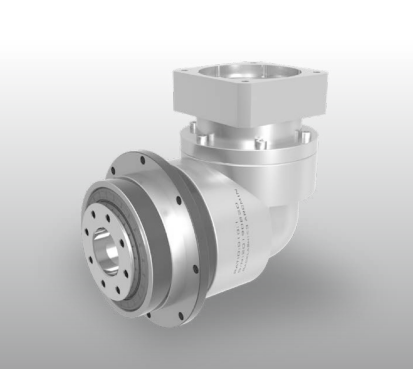
How to choose Helical or Spur Planetary Gear Reducer?
Introduction:
“Should I choose a helical planetary gearbox or a spur planetary gearbox?”
This is one of the most frequently asked questions by engineers, OEM buyers, and automation system integrators. The short answer is simple: neither is universally better. The correct choice depends on load characteristics, precision requirements, noise limits, installation constraints, and lifecycle expectations.
Planetary gear reducers are widely used with servo motors and stepper motors to reduce speed, increase torque, and optimize inertia matching. They play a critical role in industries such as lifting and conveying, construction machinery, metallurgy, mining, petrochemical processing, light industry, medical devices, instrumentation, shipbuilding, defense, and aerospace.
Understanding the fundamental differences between helical and spur planetary gear reducers is essential for making a technically sound and economically efficient decision.
Basic Structure of a Planetary Gear Reducer
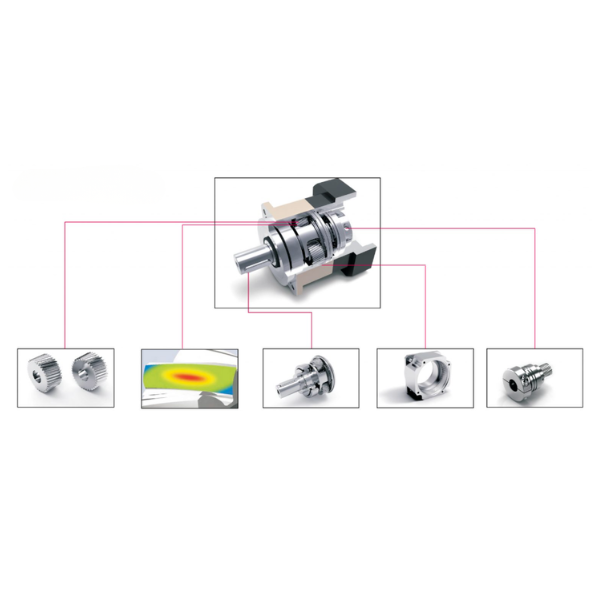
Regardless of gear tooth form, planetary gear reducers share the same core transmission architecture:
- Sun gear
- Planet gears
- Internal ring gear
- Planet carrier
This configuration allows power splitting and multi-tooth load sharing, resulting in compact size, high torque density, and good transmission efficiency. The difference between helical and spur planetary reducers lies primarily in gear tooth geometry and load behavior, not in the overall layout.
Visual and Structural Differences Between Helical and Spur Gears
Gear Tooth Orientation
Spur gears have teeth that are parallel to the gear axis. There is no axial overlap during meshing, and engagement occurs almost instantaneously along the full tooth width.
Helical gears have teeth cut at a helix angle, forming a diagonal contact pattern. As the gears rotate, tooth engagement progresses gradually from one end to the other.
This single geometric difference drives most of the performance distinctions between the two designs.
Gear Meshing Behavior and Contact Characteristics
Spur Gear Meshing
In spur planetary reducers, gear teeth:
- Enter and exit meshing abruptly
- Experience higher instantaneous impact forces
- Generate higher dynamic excitation
This behavior makes spur gear systems more sensitive to vibration, especially at higher speeds.
Helical Gear Meshing
Helical planetary reducers feature:
- Gradual tooth engagement
- A contact line that grows and shrinks smoothly
- Lower impact forces during meshing
As a result, helical gearboxes run more smoothly and quietly under comparable operating conditions.
Overlap Ratio and Load-Carrying Capacity
Understanding Gear Overlap Ratio
The overlap ratio determines how many teeth are engaged at the same time.
- Spur gears rely primarily on transverse overlap
- Helical gears benefit from both transverse and axial overlap
Because of the helix angle, helical gears have more contact area and more simultaneous tooth engagement, which significantly improves load distribution.
Impact on Torque Capacity
For the same gearbox size:
- Helical planetary reducers typically handle higher torque
- Load per tooth is lower
- Stress concentration is reduced
This makes helical designs especially suitable for high-torque and continuous-duty applications.
Transmission Error and Motion Accuracy
Contact Line Geometry
Spur gear contact lines are straight and parallel to the shaft axis. Any pitch or profile error directly translates into motion fluctuation.
Helical gear contact lines are diagonal, allowing small errors to be absorbed more gradually during engagement.
Resulting Precision Differences
In practice:
- Helical planetary reducers exhibit lower transmission error
- Motion is smoother and more predictable
- Positioning accuracy is higher
This explains why high-end servo systems overwhelmingly favor helical planetary reducers.
Torque Transmission and Efficiency Comparison
Spur Planetary Gear Reducers
Advantages:
- Simple structure
- Lower manufacturing cost
- High efficiency at low load
Limitations:
- Lower torque capacity for the same size
- Higher vibration at speed
- Less stable under shock load
Helical Planetary Gear Reducers
Advantages:
- Higher torque transmission
- Smoother operation
- Better load sharing
- Higher efficiency under real operating conditions
Trade-offs:
- Axial thrust generation
- Slightly higher manufacturing cost
In most industrial scenarios, the efficiency gains from smoother meshing outweigh the additional design complexity.
Precision Grades and Backlash Performance
Typical Backlash Levels
Spur planetary gear reducers:
- Single-stage backlash typically around 10 arcmin
- High-end designs can reach 6 arcmin
Helical planetary gear reducers:
- Single-stage backlash commonly around 5 arcmin
- Precision models can reach 1 arcmin
This makes helical designs the preferred choice for positioning systems, robotics, and CNC equipment.
Planet Carrier Support Structure Differences
Spur Gear Planet Carrier
Spur planetary reducers may use:
- Single support
- Double support
Single-support designs are simpler but more sensitive to deflection under load, which can lead to:
- Increased noise
- Higher wear
- Gradual loss of accuracy
Helical Gear Planet Carrier
Helical planetary reducers must use a double-support structure due to axial forces generated by the helix angle. This requires:
- High-precision machining
- Accurate alignment of bearing seats
- Integrated carrier and bearing assemblies
The result is a gearbox with:
- High torsional rigidity
- Stable gear meshing
- Excellent long-term precision retention
Noise and Vibration Performance
Noise and vibration are often decisive factors in modern applications.
Spur planetary gear reducers:
- Higher vibration levels
- Sharper noise signature
- Less suitable for noise-sensitive environments
Helical planetary gear reducers:
- Lower vibration
- Smoother acoustic behavior
- Better suited for medical, laboratory, and high-end automation equipment
Application-Based Selection Guidance
Spur Planetary Gear Reducers Are Suitable When
- Cost is the primary concern
- Precision requirements are moderate
- Operating speed is relatively low
- Noise is not critical
Typical applications include basic automation, simple conveyors, and general industrial drives.
Helical Planetary Gear Reducers Are Preferred When
- High precision is required
- Torque density must be maximized
- Noise and vibration must be minimized
- Long service life and stability are critical
They are widely used in robotics, CNC machinery, medical equipment, aerospace systems, and high-performance servo drives.
Frequently Asked Questions
Is a helical planetary gearbox always better than a spur one?
No. Helical designs offer superior precision and smoothness, but spur gearboxes remain suitable for cost-sensitive, low-demand applications.
Do axial forces reduce the lifespan of helical gearboxes?
No, when properly designed. Modern helical planetary reducers are engineered specifically to manage axial loads.
Can spur planetary reducers be used with servo motors?
Yes, but they are typically limited to applications with lower accuracy and noise requirements.
Why are most high-end servo systems helical?
Because low transmission error, high overlap ratio, and smooth meshing are essential for precision motion control.
Conclusion: Engineering Choice Over Simple Preference
The real question is not whether helical or spur planetary gear reducers are better, but which one aligns with your actual operating conditions.
Helical planetary gear reducers deliver:
- Higher precision
- Greater torque density
- Lower noise and vibration
- Better long-term stability
Spur planetary gear reducers remain:
- Economical
- Simple
- Reliable for standard-duty applications
Correct selection requires engineering judgment, not generalization.
NUODUN is a professional manufacturer specializing in drive systems, power transmission, and linear motion components. With deep experience in both helical and spur planetary gear reducers, NUODUN supports customers with application-based selection, customization, and technical validation.