whatsapp:+86 13622680352



How Reduction Ratio Requirements Affect Choosing Gear Reducer vs Gearbox
Introduction: Why Reduction Ratio Is the First Question to Ask
When engineers select a mechanical transmission, they often focus first on torque and speed. However, one parameter quietly drives almost every major design decision in a drive system:
The reduction ratio.
The required reduction ratio determines:
- How many gear stages are needed
- Whether a simple catalog reducer is sufficient
- When a multi-stage reducer or full gearbox becomes necessary
Understanding how ratio requirements affect the reducer vs. gearbox decision helps avoid over-engineering, inefficiency, and unnecessary cost.
This article explains how reduction ratio ranges influence transmission selection, using practical industrial logic rather than theoretical definitions.
Reduction Ratio Basics (Quick Refresher)
The reduction ratio is defined as:
Input speed ÷ Output speed
Example:
- Motor speed: 1,500 rpm
- Required output speed: 75 rpm
- Reduction ratio: 20:1
As the ratio increases, so do:
- Gear tooth loads
- Heat generation
- Size and weight
- Design complexity
This is why ratio is not just a number—it directly affects architecture choice.
1. Low to Moderate Ratios (Up to ~10:1): Simple Reducers Are Ideal
Single-Stage Reduction Sweet Spot
For reduction ratios roughly between 3:1 and 10:1, a single-stage reducer is almost always the best solution.
Common single-stage reducer types include:
- Helical reducers
- Bevel reducers
- Worm reducers
- Planetary reducers (single stage)
At this ratio range:
- Gear sizes remain reasonable
- Tooth stresses are manageable
- Efficiency is high
- Heat generation is low
This keeps the reducer compact, reliable, and cost-effective.
Typical Applications in This Ratio Range
Low–moderate ratios are common in:
- Conveyors
- Mixers and agitators
- Pumps and fans
- Simple material handling equipment
These systems usually follow a straightforward pattern:
Electric motor → reducer → load
No speed shifting, no special kinematics—just one fixed speed reduction.
Why a Simple Reducer Beats a Gearbox Here
Compared to a more general gearbox, a catalog reducer offers:
- Smaller footprint
- Lower cost
- Higher efficiency
- Faster selection and delivery
Using a multi-stage gearbox for a 5:1 or 8:1 reduction is almost always unnecessary.
2. Higher Ratios (Above ~10:1): Multi-Stage Reduction Becomes Necessary
Why You Can’t Do Everything in One Stage
As ratios increase beyond ~10:1:
- Gear diameters grow rapidly
- Tooth loading becomes excessive
- Efficiency drops
- Gear strength limits are reached
To achieve higher ratios, engineers cascade stages, where:
Total ratio = product of individual stage ratios
(e.g., 4:1 × 5:1 = 20:1)
At this point, you are entering multi-stage reducer or gearbox territory.
Multi-Stage Reducers vs. “Gearboxes”
It’s important to clarify terminology:
- Many high-ratio reducers are internally multi-stage gearboxes
- They are still called “reducers” because their only function is speed reduction and torque multiplication
For example:
- Two-stage planetary reducer (up to 100:1)
- Helical-bevel + helical reducer combination
- Worm + helical hybrid reducer
These are not shifting gearboxes—they are gearboxes optimized purely for reduction.
Efficiency and Heat Become Critical
As ratio climbs:
- Each stage adds efficiency loss
- Heat dissipation becomes a design constraint
This is why engineers often prefer:
- Planetary stages for compactness
- Helical-bevel stages for durability
- Combined architectures instead of one oversized worm stage
The goal is to balance ratio, efficiency, size, and service life.
3. When Ratio Requirements Push You Toward a “Gearbox”
There are situations where ratio requirements go beyond what a standard catalog reducer can reasonably handle.
Case 1: Very High Ratios with Special Behavior
If you need:
- Very high ratios
- Plus multiple discrete speeds
- Or forward/reverse logic
- Or special power flow
…a general gearbox design becomes more appropriate.
Examples:
- Test rigs with multiple output speeds
- Machinery with mechanical shifting
- Systems requiring speed increase + reduction
Reducers are not designed for these behaviors.
Case 2: Ratio + Torque + Space Conflict
Sometimes the challenge is not ratio alone, but the combination of:
- Very high ratio
- Very high torque
- Limited installation space
In these cases:
- Standard reducers may be too large
- Or insufficiently rated for duty cycle
- Or thermally overloaded
A custom multi-stage gearbox—often combining planetary and parallel-shaft stages—may be the only feasible solution.
4. Practical Ratio-Based Selection Guide
Simple Rule of Thumb
Up to ~10:1, fixed speed
→ Use a single-stage or simple catalog reducer
Compact, efficient, inexpensive.
~10:1 to several hundred:1, fixed speed
→ Use a multi-stage speed reducer
(planetary, helical-bevel, worm + helical, etc.)
Still a reducer, but internally a multi-stage gearbox.
Very high ratios + multiple speeds or complex layouts
→ Consider a custom gearbox rather than a standard reducer.
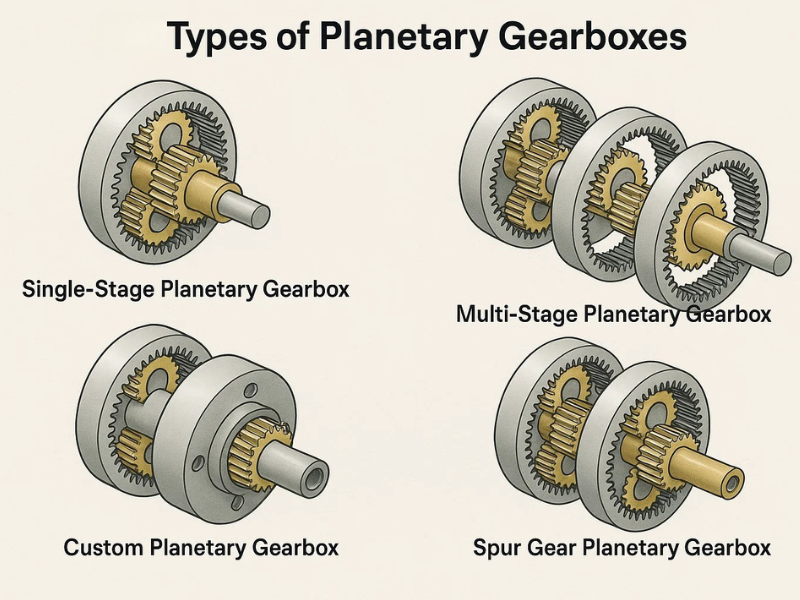
Visualizing Typical Reducer Architectures
5. Ratio Alone Is Not Enough: What Else Must Be Considered?
While reduction ratio is decisive, it never acts alone. Engineers must also consider:
- Required output torque
- Duty cycle and load spectrum
- Input speed and motor type
- Available installation space
- Noise and efficiency requirements
A 50:1 reducer for a light-duty conveyor is very different from a 50:1 reducer for a high-inertia indexing table.
This is where manufacturer expertise matters.
6. OEM Perspective: Matching Ratio to Real-World Constraints
As a professional transmission manufacturer, NUODUN sees many projects where customers initially request “a gearbox,” when what they actually need is:
- A properly staged reducer
- With the right ratio split
- Optimized for torque, heat, and space
For OEM projects, NUODUN supports:
- Custom ratio combinations
- Integrated motor-reducer designs
- Multi-stage reducers tuned for duty cycle
- Compact layouts that avoid over-sizing
This approach delivers better performance than forcing a generic gearbox into a reducer application.
Frequently Asked Questions (FAQ)
Q1: Is there a hard limit for single-stage reducers?
There is no absolute limit, but beyond ~10:1, gear size, stress, and efficiency usually make multi-stage designs more practical.
Q2: Are multi-stage reducers still considered reducers?
Yes. As long as their sole purpose is speed reduction and torque increase, they are reducers—even if internally they are multi-stage gearboxes.
Q3: Why not always use a worm reducer for high ratios?
Worm reducers can achieve high ratios, but efficiency and heat become limiting factors at high power or continuous duty.
Q4: Does higher ratio always mean lower efficiency?
Generally yes, because efficiency losses compound with each stage. Proper stage selection minimizes this effect.
Q5: Can NUODUN customize ratio splits for OEM applications?
Yes. NUODUN provides OEM and ODM solutions with customized ratio staging to optimize size, efficiency, and service life.
Final Summary: Let Ratio Guide the Architecture
Reduction ratio requirements are one of the strongest drivers in choosing between:
- A simple reducer
- A multi-stage reducer
- Or a full gearbox
As ratios increase and requirements become more complex, solutions naturally evolve from simple reducers toward multi-stage gearbox architectures.
Choosing the right architecture early saves cost, space, and engineering time.
Get the Right Ratio, the Right Way
If your application requires:
- Low or high reduction ratios
- Compact, efficient speed reduction
- OEM-level customization for torque, space, and duty cycle
NUODUN is a transmission equipment manufacturer specializing in gear reducers, multi-stage reducers, and custom gearbox solutions.
Contact NUODUN today to discuss your reduction ratio requirements and develop the optimal transmission solution for your machine.