whatsapp:+86 13622680352



NUODUN Screw Jack Installation Guide
Correct installation is the primary driver of stability, repeatability, and service life in screw jack systems. This guide covers vertical and horizontal installation, tension vs. compression loading, guide requirements, buckling prevention, long-spindle support, travelling nut solutions, articulated mounting for angular motion, and a practical commissioning checklist. Any diagrams used on this page are for reference only; final engineering should follow your project drawings and verified calculations.
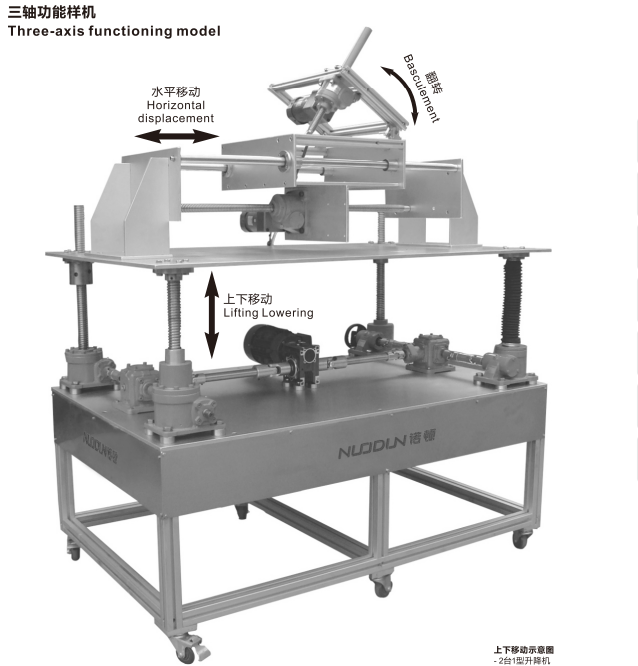
Before You Install: Define Load Direction and Motion
Before choosing brackets, guides, and accessories, confirm how the spindle is loaded and how the platform moves. Most field issues (vibration, noise, premature wear, jamming) originate from an installation that unintentionally introduces side loads or excessive unsupported length.
Tension-Loaded Spindle (Preferred for Long Strokes)
A tension-loaded spindle is “pulled straight,” which makes it inherently more stable.
- Lower sensitivity to buckling
- Better for long strokes and long spindles
- More tolerant of minor disturbances compared to compression loading
Compression-Loaded Spindle (Higher Risk Without Proper Guiding)
A compression-loaded spindle behaves like a slender column under push load.
- Highest sensitivity to side loads and misalignment
- Requires reliable lateral guiding and/or intermediate supports
- Buckling risk often governs design, not thread strength
Vertical Installation
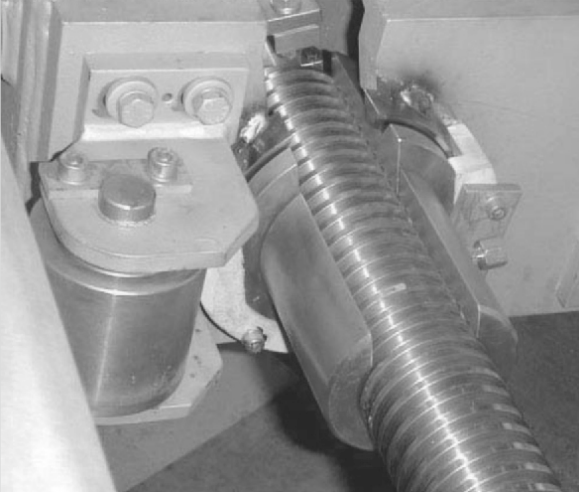
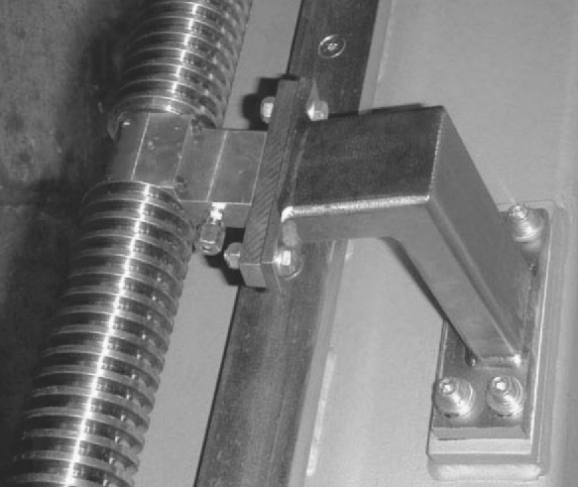
Vertical installations are common in lifting platforms, presses, gates, and positioning columns. The most stable vertical layout is typically the one that keeps the spindle primarily in tension.
Recommended Layout for Long Stroke: Tension Loading
For large lifting strokes and long spindles, a tension-loaded arrangement is generally recommended to reduce buckling sensitivity and improve repeatable positioning.
Reference Layout Note: A tension-loaded vertical arrangement is typically selected when long stroke, high stability, and repeatable positioning are priorities.
Protection Tube Considerations
If the environment contains dust, metal chips, abrasive particles, or splash contaminants, a protection tube helps maintain thread integrity and reduces maintenance.
- Protects spindle surface and thread form
- Improves reliability in continuous duty environments
- Helps reduce contamination-related jamming and abnormal wear
Compression Vertical Installation Without Lateral Guides (Use With Caution)
When a vertical spindle must work in compression and lateral guiding is limited, the installation becomes highly sensitive to buckling and side-load amplification.
Recommended controls:
- Reduce effective unsupported length
- Add guiding elements where possible
- Minimize eccentric loading and keep the load line coaxial with the spindle axis
- Use conservative buckling assumptions during sizing
Reference Layout Note: Compression-loaded vertical arrangements without strong lateral restraint typically require stricter design controls and verification.
Horizontal Installation
Horizontal screw jack systems are widely used for push–pull positioning, traversing mechanisms, and tension/compression fixtures. Compared to vertical installations, horizontal layouts typically demand stronger guide design due to deflection and lateral load sensitivity.
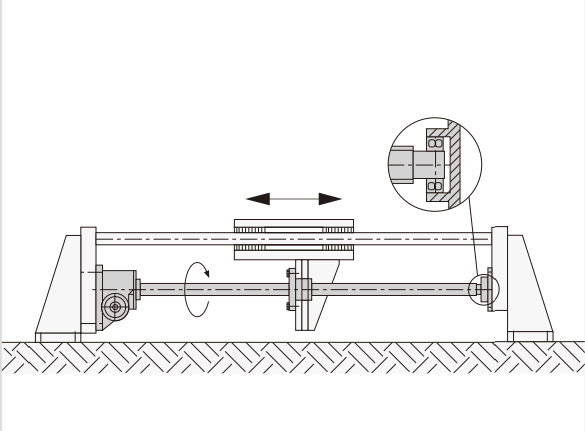
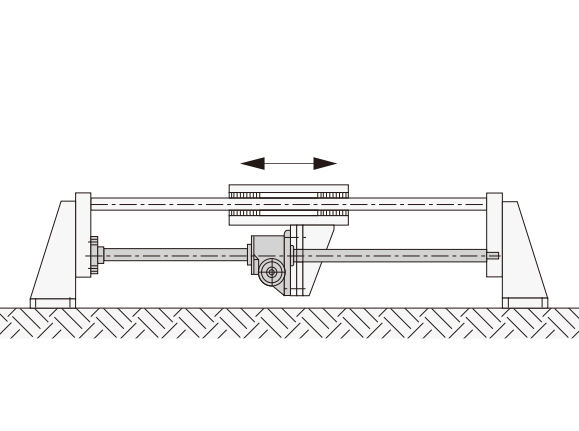
Guides Are Typically Mandatory
Horizontal systems are more prone to:
- Spindle deflection from self-weight
- Side loads from imperfect alignment or uneven platform constraints
- Nut misalignment, resulting in uneven wear or jamming
Best practice: use linear guides (rails, rollers, sliders, guide blocks) that carry side loads so the screw jack primarily carries axial load.
Two Common Design Concepts
Design Concept A: Retained Spindle + Traversing Drive Axle
- Often preferred for longer spans because it reduces the behavior of a long rotating spindle
- Can improve stability and reduce speed-related vibration risk
- Works well when strong onsite guides are available
Design Concept B: Turning Spindle + Travelling Nut
- Enables linear motion via a travelling nut
- Must account for critical speed limitations and stability
- Commonly combined with intermediate supports and robust guiding
Reference Layout Note: Horizontal arrangements generally assume that the guide system is designed to carry lateral loads, with the screw jack carrying primarily axial load.
Long Spindles, Critical Speed, and Intermediate Supports
As spindle length increases, the system becomes more sensitive to vibration, runout, and stability limits—especially when the spindle rotates. Intermediate supports and travelling nut solutions help stabilize long-stroke and long-span systems.
When Intermediate Supports Become Necessary
Consider intermediate bearing/support elements when one or more conditions apply:
- Long spindle length or long stroke
- Higher spindle rotational speed requirements
- Horizontal rotating spindle layout
- Limited lateral guiding or unavoidable side forces
- Requirement for smooth operation with low vibration and long service life
Intermediate supports reduce effective free length and help control vibration and whip.
Travelling Nut Solutions for Long Traversing Movements
A travelling nut configuration can improve stability in traversing systems, particularly when:
- The spindle is long and speed must remain moderate to high
- The mechanism requires consistent linear motion over distance
- The guiding system is designed to carry lateral forces
Reference Layout Note: For long spindles operating near stability limits, travelling nut concepts are commonly paired with intermediate supports and a defined guiding structure.
Guides and Buckling Checks (Euler Cases)
In compression, spindle sizing is frequently governed by buckling rather than thread capacity. Installation constraints—end conditions and guide quality—determine the effective length and allowable load.
Why Buckling Checks Matter
- Compression-loaded spindles can fail by buckling even when axial load is below nominal thread capacity
- End restraint quality and guide stiffness directly affect the allowable load and stroke
- Conservative assumptions are recommended when guiding or restraint is uncertain
Practical Interpretation for Installation
- Stronger end restraint + better guides → shorter effective free length → lower buckling risk
- Weaker restraint or insufficient guiding → longer effective free length → more conservative sizing required
- If spindle retaining stiffness is insufficient, treat the system as a more conservative buckling condition
Swiveling/Angular Motion: Articulated Mounting
If the platform or linkage introduces angular movement (swinging, tilting, hinged motion), rigid mounting can impose side loads on the spindle and accelerate wear.
When Articulated Mounting Is Required
Use articulated mounting when:
- The platform rotates, tilts, or swings during movement
- The load path changes angle during travel
- Misalignment cannot be fully eliminated by structure
Recommended measures:
- Articulated joints to release angular misalignment
- Guide rings or equivalent elements to control lateral motion path
- Protection elements when contamination or impact risk exists
Commissioning Checklist
Follow a staged commissioning approach to avoid early failures and hidden alignment issues.
Alignment and Mechanical Checks
- Verify mounting surfaces are flat and secure
- Check coaxial alignment between spindle axis and load path
- Confirm guide rails/rollers are parallel and carry lateral forces
- Ensure couplings and shafts are aligned and not preloaded
Safety Clearance at Stroke Limits
Reserve safety clearance at both ends of stroke to prevent hard stops under load. This is critical in multi-jack synchronized systems where small timing differences can produce impact.
Step-by-Step Trial Run
- No-load run: check vibration, noise, smoothness, runout
- Partial-load run: inspect guide contact, temperature rise, abnormal wear marks
- Full-load validation: verify holding performance, repeatability, backlash behavior, and synchronization accuracy (if multi-jack)
NUODUN Selection Guidance by Load Segment
The guidance below helps match typical duty levels to a screw jack configuration strategy. Final selection should confirm stroke, duty cycle, speed, installation constraints, guide availability, and a verified safety margin against buckling in compression.
Light Duty (≈ 0.5–5T)
Best for compact automation and light lifting/positioning.
- Priority: compact design, smooth motion, cost efficiency
- Installation focus: alignment and basic guiding (especially horizontal)
- Typical direction: trapezoidal screw solutions for general positioning
Medium Duty (≈ 5–20T)
Common in industrial equipment, fixtures, and production lines.
- Priority: stable guiding strategy and predictable repeatability
- Installation focus: manage side loads; consider travelling nut for long traversing movements
- Consider intermediate support when stroke/length increases or speed rises
Heavy Duty (≈ 20–50T)
Used in presses, heavy platforms, large fixtures, and synchronized lifting.
- Priority: structural stiffness, robust guiding, conservative safety factors
- Installation focus: compression buckling checks are often decisive; minimize unsupported length
- Multi-jack synchronization requires strict alignment and safety clearance planning
Ultra Heavy Duty (≈ 50–150T)
High-load lifting platforms, large machinery adjustment, special heavy fixtures.
- Priority: engineered arrangement with strong end restraint and guiding
- Installation focus: avoid unintended side loads; intermediate supports are frequently necessary in long-stroke or horizontal systems
- Recommend engineering review for layout and buckling margin before finalizing
Get a NUODUN Installation Review & Selection Proposal
If you share your load, stroke, speed, duty cycle, and installation orientation, NUODUN can provide:
- Layout recommendation (tension vs. compression arrangement)
- Guide strategy suggestion (rails/rollers/guide blocks)
- Spindle stability approach (buckling margin, intermediate supports)
- Configuration proposal (retained spindle vs. turning spindle + travelling nut)
- Drawings and BOM support for fast integration s
Contact NUODUN
Send your basic parameters and application details to receive a tailored selection and installation recommendation.
FAQ
Do horizontal screw jack systems always need guides?
In most industrial applications, yes. Guides carry lateral loads so the screw jack remains primarily axial-loaded, improving service life and motion stability.
Is a thicker spindle always enough to prevent buckling?
Not always. Buckling depends strongly on effective unsupported length and end restraint. Better guiding and reduced free length can be more effective than simply increasing diameter.
When should I add intermediate supports?
When spindle length becomes significant, speed increases, the spindle rotates in a horizontal layout, or guiding is limited. Intermediate supports reduce free length and improve stability.
When is a travelling nut configuration recommended?
When long traversing movement is needed, stability must be improved for longer spans, or the system benefits from combining guiding with a travelling element rather than relying on a long rotating spindle alone.